|
PLEASE PATRONIZE OUR SPONSORS!





|
|||||||
 |
|
|
Thread Tools | Display Modes |
|
#151
 07-20-2011, 09:39 PM
|
||||
|
||||

It's nothing to lose sleep over... An 8.50 wide tire fits a 7 inch rim. A 10.50 tire normally goes onto a 7.5 inch rim. The 10.50 tire will fit the 7 inch rim ok, it will just simply pull the tread in on the sides some. I mounted the wide tire on a 7 inch rim with no issues. Some guys in here have mounted the 8.50 tire onto the narrow 6 inch rim and they look awesome on the older cubs. Don't over think it too much. And yes, they are 23 inches tall. The rim is 12 inches from top to bottom.
__________________
DWayne 1973: 128, ag tires, 3pt. lift, spring assist, lights, 42" Deck 10" moldboard plow 2016 XT1 42" deck 18HP 
|
|
#152
07-20-2011, 10:02 PM
|
||||
|
||||
|
A 10.50 tire came on an 8.5" rim on a CC, as did the 26-12-12s, although with a different offset.
Regardless of how 'cool' it looks mounted on the wrong rim, the tire will work better if it is mounted on the size of rim it is designed for.
|
|
#153
07-20-2011, 10:39 PM
|
||||
|
||||
|
Yep I had 7 inch on my mind all thru that, LOL.
I'm still trying to figure out the issue of whether a tire works good or not depending on the rim and certain brands, etc. I have plowed, mowed, worked with tires on rims as I mentioned, with wider tires on a narrower rim and also on correct width rims. I think unless your are pulling competition or doing some serious 12 inch moldboard plowing in hard packed ground, the wider tires all work great no matter if on a smaller rim or on a "correct" rim. Ags will grab and will pull, turf tires will, well do what turf tires do also. The only good differences I have seen is the advantage of fluid filled tires or wheels with weights to enhance pulling and grip. For 99% of the people out there, doing the average home and yard work it won't matter much of which wheel they will use. The tire on the other hand makes a huge difference. As most have seen, Ags for most of the year and then changing over to turfs with chains seems to do the best with snow removal. Granted I know nothing of snow removal, we have little to no snow removal in this section of the country. Just my 2 cents from real life experience. Of course we all know about opinions  . .
__________________
DWayne 1973: 128, ag tires, 3pt. lift, spring assist, lights, 42" Deck 10" moldboard plow 2016 XT1 42" deck 18HP
|
|
#154
07-20-2011, 11:00 PM
|
||||
|
||||
|
The reason I say that is because if you put a tire on a rim that's narrower than what is supposed to be used, or inflate the tire too much on the correct rim, it balloons out and less of the tread is contacting the ground. Ideally the tread profile should all be touching the ground.
Will you notice any difference? I don't know...I just try to do the best I can with what I have. My 35-year-old tires will have the best chance of working properly when they're mounted on the correct rims and properly inflated. Things are usually the way they are for a reason. I used to have a rather large PDF file of a document from Goodyear that explained more than you ever wanted to know about tires, including this subject, and what tread patterns work best for different soils. Unfortunately I haven't been able to find it in awhile. I think I lost it during a hard drive swap a couple years ago.
|
|
#155
07-21-2011, 02:52 AM
|
||||
|
||||
|
Quote:
I now remember doing the rim width thing while putting big tires on a Ram 3500 4x4 I owned. The only way I'm going to be able to determine my rim width is to measure it with a tire off, I guess. I want to be able to determine how much tire width I can put on the tractor within the confines of my current rims, and the confines of the fenders / hubs overall. I know offsets factor in here as well. Fat is good.  BTW, I'm kind of thinking about going toward industrial tires like those found on the Yanmar Cubs, rather than Ag tires.
|
|
#156
07-21-2011, 03:42 AM
|
||||
|
||||
|
De-Rusting parts
Check this out:
I was talking to a neighbor about my project last week, and I told him that I was planning on building an electrolytic cleaner to de-rust parts. He works in a manufacturing company. When I told him that if all goes well, I may upscale my electrolytic system to a 55 gallon drum, he told me he could get me one for free. Cool, a free plastic drum. Then he told me that they had 10 gallons of this industrial de-ruster at the shop that they weren't using - and I could have it, free. I said I'd try it. From what I understand, it's a citrus-based product, the MSDS numbers on it are very low (as in, safe to near Windex numbers) so I wanted to give it a try. So before I build my electrolytic cleaner, I tested this stuff in a 5 gallon pail. He told me it was 4 parts water, 1 part solution and a 24 hour soak. I grabbed up a few parts for a trial run. I wound up soaking for 36 hours because I forgot about it until this evening. Here are some before and after pics: A few hangers from the mower deck: . Before: 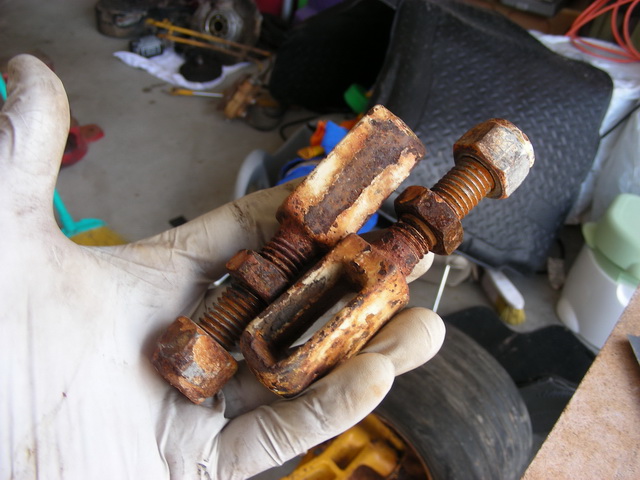 . After soak: 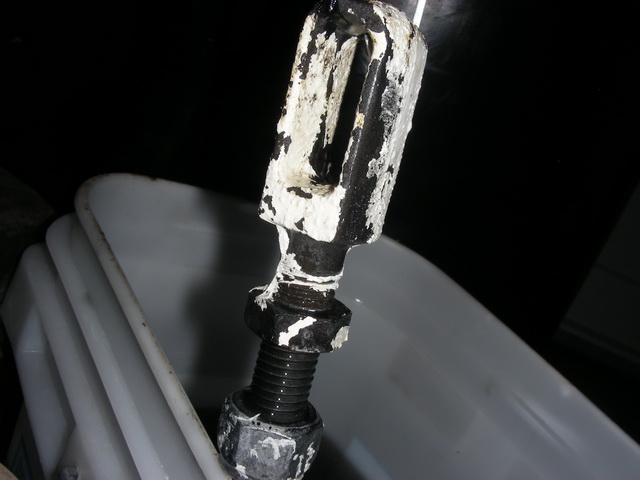 . And a very easy wire-wheeling: . 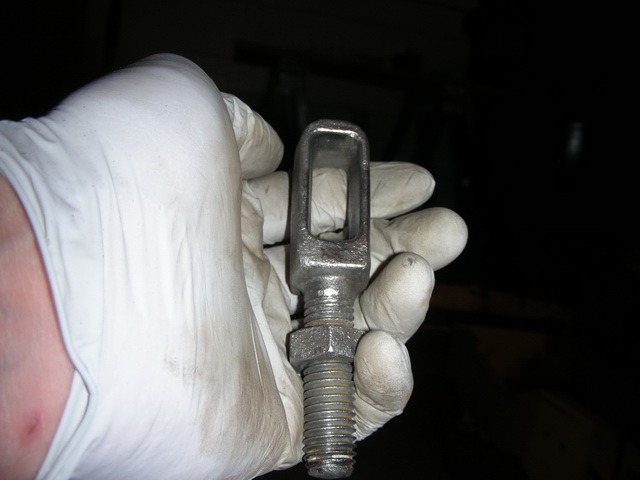 . The footrest plates didn't dip all the way in, which provides a nice contrast of before and after: . Before: . 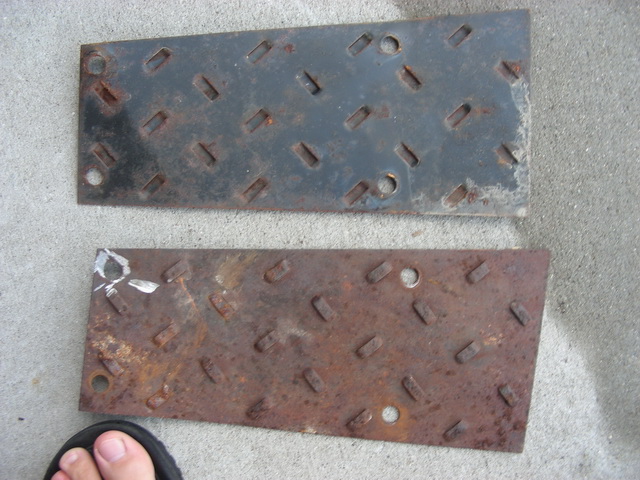 . After rinsing and toweling it off, most of the paint came off: . 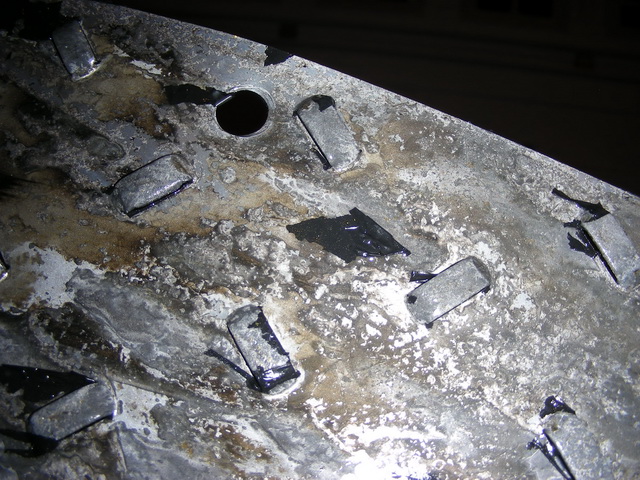 . And again, some very easy work with the 3/8 drill using a flap disc sander and a wire wheel for the tight spots. The rust line is the dip line: . 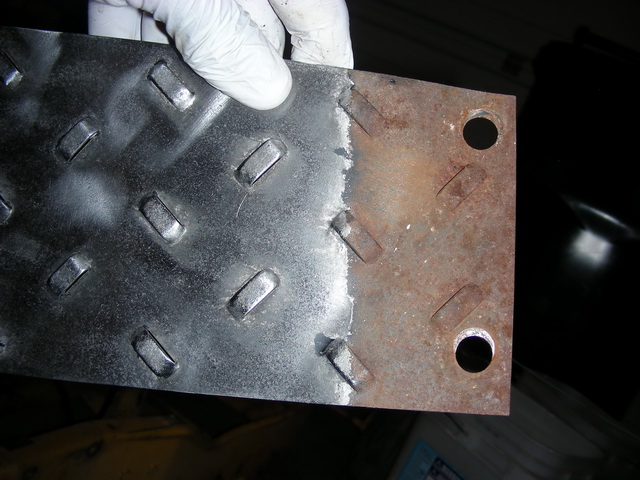 . I think I like this stuff! I'd still like to build the electrolytic cleaner to compare results, but from what I've seen in pictures and video, this stuff is equal to - if not better than - the results guys are getting with electrolytic. I'll give you some details on the product later - although, I'm pretty sure you can't buy it unless you're an industrial company, because I couldn't even get info on the chemistry and directions on the web...
|
|
#157
07-21-2011, 08:49 AM
|
||||
|
||||
|
Yes, I was referring to rim width.
Electrolysis is a great way to clean parts. You can get good results with washing soda, as well. The paint will fall off and what remains can usually be wire-wheeled off easily.
|
|
#158
07-21-2011, 11:15 AM
|
||||
|
||||
|
You're talking about using washing soda with electrolysis, right?
I bought lye for the electrolytic cleaner. A friend of mine is a chemist, and told me that he thought trisodium phosphate would work even better, as it would anodize the parts after de-rusting them. After shopping for TSP, I learned that Michigan was one of 17 states that banned its sale. But fortunately, I can get a 4.5 lb box of it online for about $20 with shipping. I'm going to put an order out for it. This stuff is also excellent to add to your dishwasher and clothes washer, about a teaspoon added will really improve your results from what I've heard.
|
|
#159
07-21-2011, 11:39 AM
|
||||
|
||||
|
Quote:
For your info, I got my axle seals at O'Reilly's for $4.00 each....the were National Seals part number 471224, you should be able to cross reference this number at any auto parts store, I think the ones from Cub Cadet dealer were $6.00+ each.
__________________
Jeff Brookfield, MO ________________ IH Red 782 with weights and sleeve hitch! IH snow blade, Brinly plow, Brinly disk, Brinly harrow, Johnson rear blade, and a #2 IH Cart
|
|
#160
07-21-2011, 11:48 AM
|
||||
|
||||
|
Quote:
Are those needle bearings going to want to fall apart when I take them out, or are they held into the assembly? I hate dealing with bearings that fall apart when you move them.
|
|
|
|
Cub Cadet is a premium line of outdoor power equipment, established in 1961 as part of International Harvester. During the 1960s, IH initiated an entirely new line of lawn and garden equipment aimed at the owners rural homes with large yards and private gardens. There were a wide variety of Cub Cadet branded and after-market attachments available; including mowers, blades, snow blowers, front loaders, plows, carts, etc. Cub Cadet advertising at that time harped on their thorough testing by "boys - acknowledged by many as the world's worst destructive force!". Cub Cadets became known for their dependability and rugged construction.
MTD Products, Inc. of Cleveland, Ohio purchased the Cub Cadet brand from International Harvester in 1981. Cub Cadet was held as a wholly owned subsidiary for many years following this acquisition, which allowed them to operate independently. Recently, MTD has taken a more aggressive role and integrated Cub Cadet into its other lines of power equipment.
This website and forum are not affiliated with or sponsored by MTD Products Inc, which owns the CUB CADET trademarks. It is not an official MTD Products Inc, website, and MTD Products Inc, is not responsible for any of its content. The official MTD Products Inc, website can be found at: http://www.mtdproducts.com. The information and opinions expressed on this website are the responsibility of the website's owner and/or it's members, and do not represent the opinions of MTD Products Inc. IH, INTERNATIONAL HARVESTER are registered trademark of CNH America LLC
All material, images, and graphics from this site are the property of www.onlycubcadets.net. Any unauthorized use, reproductions, or duplications are prohibited unless solely expressed in writing.
Cub Cadet, Cub, Cadet, IH, MTD, Parts, Tractors, Tractor, International Harvester, Lawn, Garden, Lawn Mower, Kohler, garden tractor equipment, lawn garden tractors, antique garden tractors, garden tractor, PTO, parts, online, Original, 70, 71, 72, 73, 76, SO76, 80, 81, 86, 100, 102, 104, 105, 106, 107, 108,109, 122, 123, 124, 125, 126, 127, 128, 129, 147, 149, 169, 182, 282, 382, 482, 580, 582, 582 Special, 680, 682, 782, 782D, 784, 800, 805, 882, 982, 984, 986, 1000, 1015, 1100, 1105, 1110, 1200, 1250, 1282, 1450, 1512, 1604, 1605, 1606, 1610, 1615, 1620, 1650, 1710, 1711, 1712, 1806, 1810, 1811, 1812, 1912, 1914.


 Linear Mode

